US / THEM

US / THEM
QB Gallery / Blomqvist Kunsthandel
Competition seems to play a minor role as a driving force within the collegial networks of contemporary artists. Historically, however, technical innovation has often been a crucial factor in artistic development. Filippo Brunelleschi’s “rediscovery” of linear perspective, for instance, marked a clear divide between the flat surfaces of medieval art and the following centuries’ fascination with creating three-dimensional depth in pictorial space.
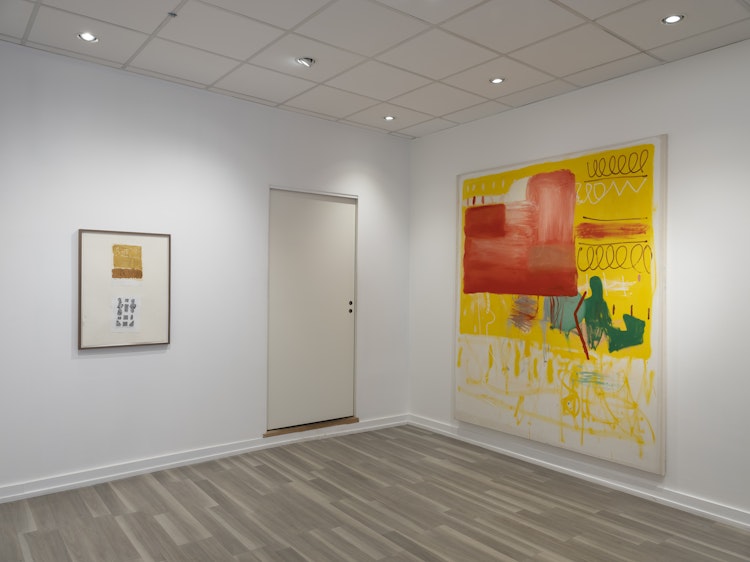
If there is any trace of a comparable competitive instinct in today’s art field, it might be found in the expressionist, non-figurative painting of artists such as Sebastian Helling. His assertive and outward-facing rhetoric (“I run this (Full Stop)”) reflects a sensibility inspired as much by “battle”-oriented cultural forms as by painting’s own high-aesthetic tradition. While this attitude is not uncommon in the long history of bad painting, anti-composition, and painterly defiance, Helling’s use of his initials and fragments of detached text follows a logic where action precedes thought, where the act of painting itself takes priority over conceptual control. It is as though the body overrides the brain’s impulse to dictate the outcome.
This approach unfolds as an intuition-driven vitality, where the mixture of large and small gestures stems from facing every blank canvas as if beginning entirely from scratch. Each painting starts from an almost pre-cerebral instinct, a primal urge to fill the surface. The result is a sense of unstoppable energy and spontaneity.
From a technical standpoint, Helling’s extensive use of aerosol paint, or spray cans, is worth highlighting. Traditionally associated with a lowbrow aesthetic, spray paint became part of his vocabulary with the works made in 2015 during a residency at Hooper Projects in Los Angeles. This period marked a turning point: his palette shifted from dark, heavy tones toward a lighter, more vivid, and colourful range.
The paintings combine conventional brushwork with sprayed pigment, and in the tension between these approaches a vibrating field of painterly meaning emerges. Perhaps this is what critic Tommy Olsson referred to in 2016 as a “sublime, diffuse membrane of uncertainty.” The rawness of Helling’s technique evokes the spirit of Surrealist automatic writing, a direct, unbroken chain of transferred energy from the artist’s inner state through the motion of the hand, whether controlling a brush or a spray can. As with all great expressive painting, the artist is fully present in the work. These paintings, more than anything, reflect Helling himself.
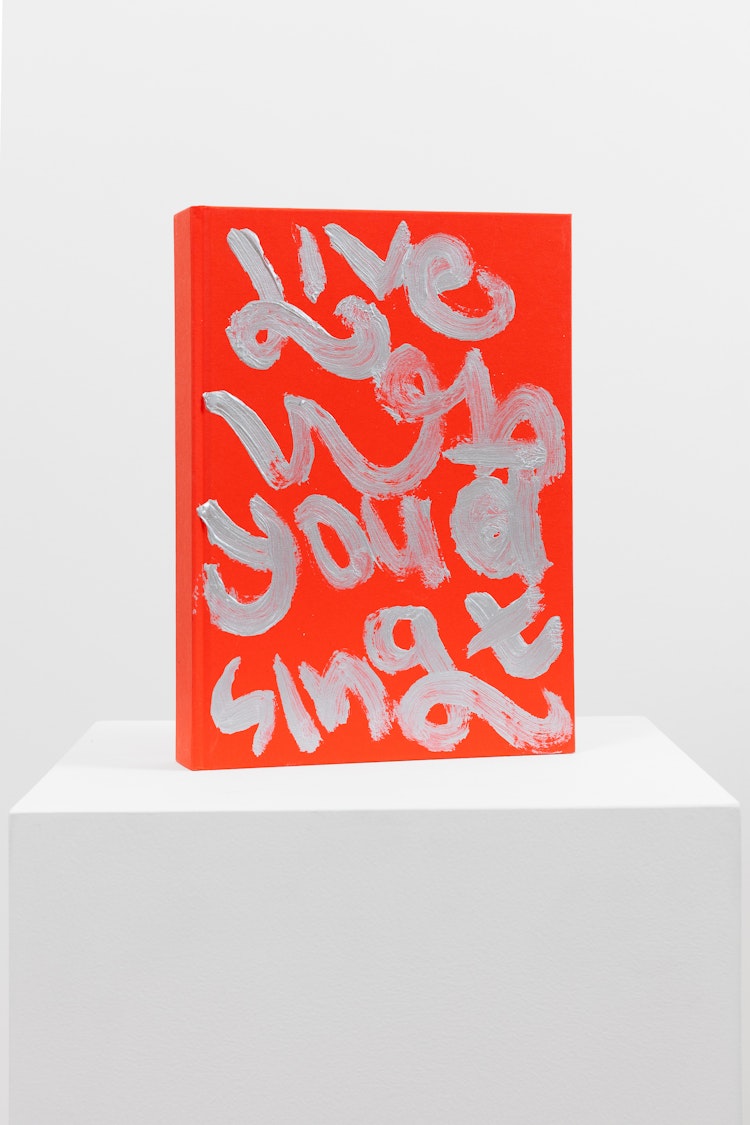
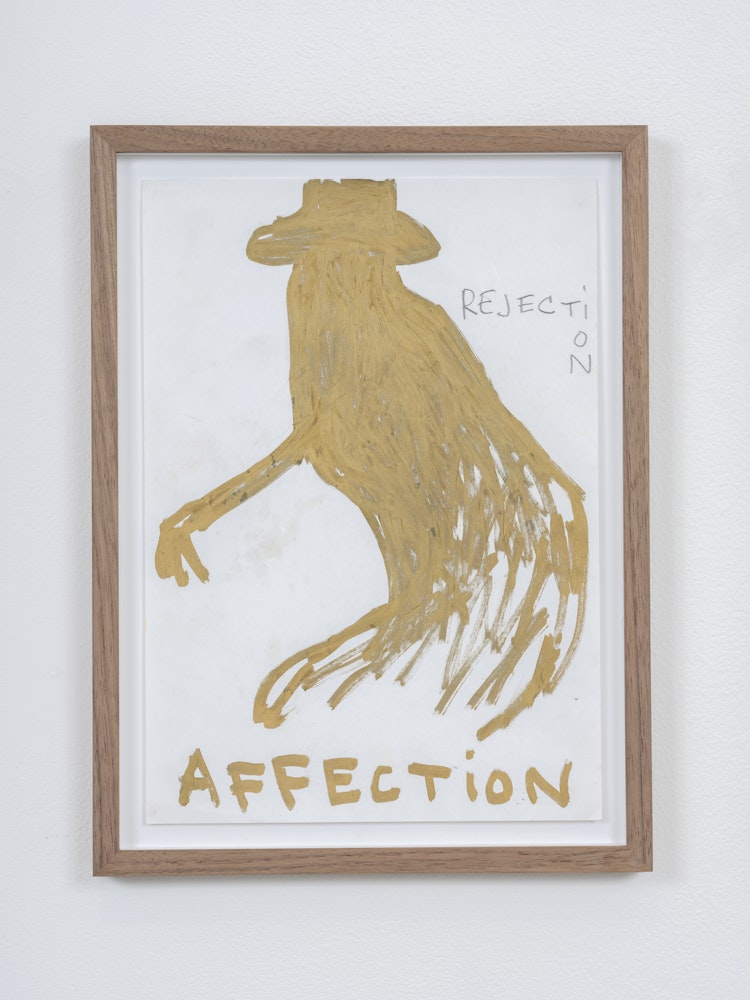
That same energy pulses through the 400-page book published in conjunction with the exhibition, the first volume in a series presenting Helling’s drawings. Here, we encounter the artist in an even more unrestrained and explosive mode. The book features sketches and image fragments, some recognizable from the paintings: shards of text, experimental linework, near-symmetrical compositions, borrowed or half-remembered forms, and newly discovered figurative shapes. Page after page, the drawings reveal a compulsive process in which the hand must remain in motion, whether holding a brush, pencil, spray can, or marker.
Both in his drawings and paintings, Helling’s work can be understood as a continuous struggle with the artistic self, a dynamic push and pull between signature and recognizability on one side, and innovation and unpredictability on the other. Each canvas carries the urge to extend the previous one, as part of an ongoing pursuit of a future totality, a whole that remains perpetually out of reach. The impossibility of seeing the full picture becomes, in itself, the very core of the project’s strength.
In this way, Helling’s paintings and drawings can each be seen as fragments, autonomous works that nonetheless point toward a larger totality, one that ultimately exists only in the artist’s own mind.






What are you looking for?